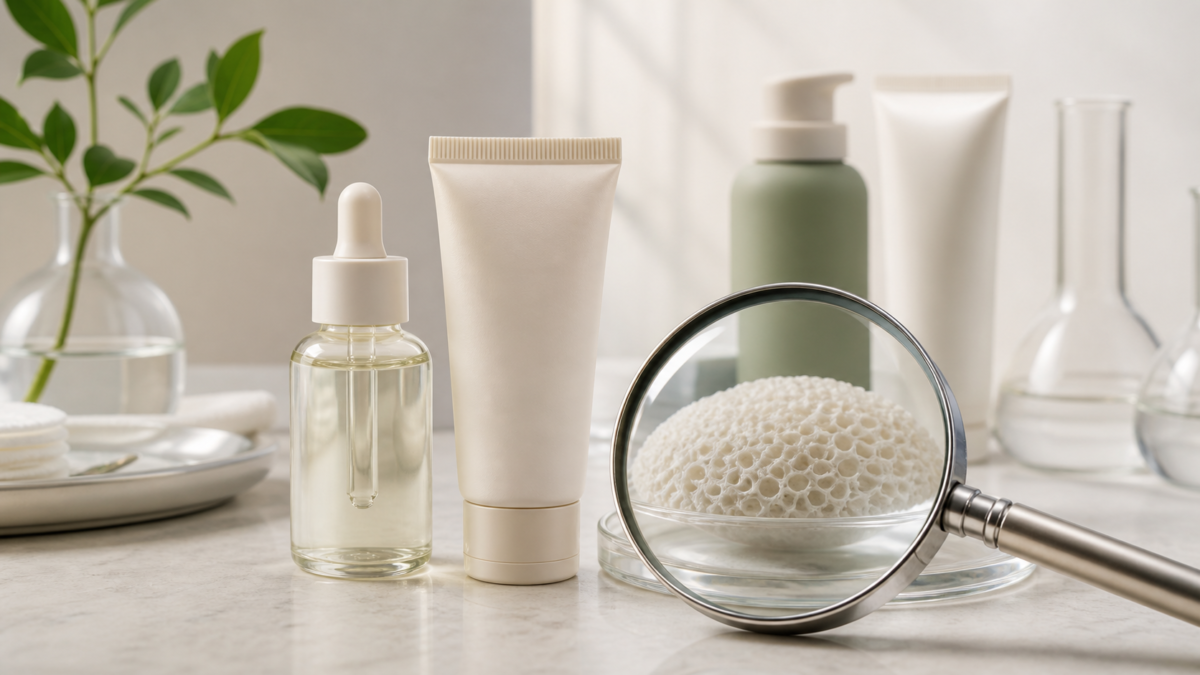
Spicule skincare has become one of K-beauty’s most discussed texture-driven trends. Products may describe microscopic, needle-like mineral structures—often associated with marine sponge material—that create a prickling sensation when massaged onto skin. Marketing sometimes compares that sensation with microneedling or suggests that it opens pathways for other ingredients. Those comparisons require caution. A leave-on cosmetic, a short blunt exfoliating product, a powered microneedling device, and a professional radiofrequency procedure are not interchangeable. Their depth, intended use, evidence, regulation, and risks differ. This guide explains how U.S. shoppers can evaluate spicule claims in 2026, what FDA guidance says about microneedling devices and delivery of topical products, how limited product-specific evidence should be interpreted, and when tingling should be treated as a warning rather than proof that a formula works.
What Spicule Skincare Claims to Be
In beauty marketing, “spicules” commonly refers to tiny rigid structures incorporated into a topical formula. Depending on source and processing, the material, shape, purity, amount, and surface coating can vary. A product may be positioned for exfoliation, smoother-looking texture, radiance, or enhanced delivery of accompanying ingredients. The consumer often notices transient prickling during application.
Sensation is not a standardized dose. Two products using the same headline number may not contain identical materials or produce equivalent contact with skin. Massage pressure, skin condition, formula vehicle, application amount, and individual sensitivity affect the experience. A stronger sting does not prove deeper or more useful delivery.
Read the complete ingredient list and directions rather than relying on a front-label “shot” or “needle” metaphor. Identify whether the product names hydrolyzed sponge, sponge-derived material, silica, an ingredient complex, or only proprietary terminology. If the brand does not explain what its number measures, consumers should not assume it represents count, concentration, depth, or clinical strength.
Why It Is Not the Same as Professional Microneedling
The FDA defines microneedling devices as instruments with many needles, tips, or pins that repeatedly enter and leave the skin. Its microneedling device page says legally authorized devices have specific uses, body areas, and patient populations. Authorized medical devices are not a blanket endorsement of every needle-like product.
The FDA also explains that products with short or blunt projections that do not penetrate living skin layers and claim only exfoliation or improved appearance may not be medical devices. Intended use and physical characteristics matter. A cosmetic spicule serum cannot borrow the authorization or clinical record of a professional device simply because both are described with microscopic “needles.”
Most importantly, the FDA says microneedling devices are not approved for delivering cosmetics, topical medicines, vitamins, drugs, or blood products into skin. Its consumer safety update states that the agency has not cleared a microneedling device for use with another product. Therefore, combining a home roller or stamp with a spicule serum is not an evidence-based shortcut and can add unpredictable exposure and infection risk.
What the Current Evidence Can and Cannot Show
Research on spicule delivery platforms is emerging, but it is not yet a universal verdict on retail K-beauty formulas. Laboratory work can show changes in models or ingredient movement under controlled conditions. Small clinical studies may evaluate a particular material, coating, concentration, protocol, and outcome. Those findings do not automatically transfer to a differently manufactured serum.
A recent paper indexed by the National Library of Medicine studied a nano-encapsulated secretome coated on marine sponge-derived spicules in preclinical and clinical evaluation. The published record describes a specific experimental platform, not proof that all commercial spicule products rejuvenate skin or safely deliver any active ingredient.
Useful questions include whether a study tested the finished product, whether it had a control group, how many people participated, how long follow-up lasted, which skin types were represented, who funded the research, and whether adverse events were systematically recorded. Before-and-after images without standardized lighting or a comparison group are weak evidence.
Consumer reviews are valuable for texture and packaging impressions but cannot establish penetration depth, biological mechanism, or treatment of disease. Claims to rebuild collagen, treat acne, heal scars, or change living tissue may also move beyond cosmetic appearance and raise drug or device regulatory questions.
How to Evaluate a U.S. Product Listing
A traceable listing should identify the responsible company, net contents, complete ingredients, directions, warnings, and a way to report a problem. Korean domestic packaging alone may not provide the English information needed for informed U.S. use. Buy from a seller that can verify authenticity and lot information.
Separate cosmetic claims from medical comparisons. “Improves the look of texture” is different from “creates microchannels to deliver medicine” or “remodels scars.” Search for an FDA authorization only when a seller claims a device is cleared or authorized, and verify the exact manufacturer, model, indication, and intended body area in the agency database.
Do not confuse FDA facility registration, cosmetic product listing, or imported status with individual premarket approval. Cosmetics generally do not receive FDA approval before sale, apart from color additives. A retailer should not place an FDA logo or imply that a cosmetic spicule formula is the equivalent of an authorized device.
A Conservative Use Checklist
- Begin with healthy, intact skin. Do not apply over cuts, sunburn, a rash, picked acne, or a recent procedure.
- Read the directions. Follow the labeled amount, frequency, massage method, and areas to avoid.
- Introduce one change. Keep cleanser, moisturizer, and sunscreen stable so irritation has an identifiable cause.
- Avoid aggressive stacking. Do not start strong exfoliating acids, retinoids, scrubs, benzoyl peroxide, and spicules together.
- Keep tools separate. Do not add a dermaroller, stamp, or professional device unless a qualified provider directs an authorized use.
- Protect from sun. Use broad-spectrum sunscreen and avoid deliberately exposing irritated skin.
- Stop for warning signs. Persistent pain, swelling, blistering, hives, spreading redness, discharge, or pigment change deserves prompt attention.
A small-area trial may reveal obvious intolerance, but it cannot guarantee future safety. Wash hands before application, keep packaging closed, and do not share products that require direct contact with skin. Avoid rubbing eyes after handling the formula.
If a product feels more intense with each application, do not interpret this as progress. Reduce variables and allow skin to recover. A bland moisturizer may support comfort, but it does not neutralize an injury or allergy. Seek medical care rather than layering soothing products over a worsening reaction.
Who Should Pause and Ask a Professional
People with active eczema, psoriasis, rosacea flares, infection, cold sores, open acne lesions, a history of keloids, impaired healing, significant pigment disorders, or recent peels, lasers, or microneedling should consult a qualified clinician before using a prickling product. Prescription acne treatment and isotretinoin history also require individualized advice.
The FDA lists bleeding disorders, immune suppression, uncontrolled diabetes, active infection, certain skin diseases, darker skin with pigment-change risk, pregnancy, breastfeeding, and other circumstances among considerations for medical microneedling. Those device warnings do not automatically define a cosmetic spicule contraindication, but they demonstrate why “needle-like” comparisons should not be treated casually.
Radiofrequency microneedling is a different medical procedure. In an October 2025 safety communication, FDA reported serious complications with certain uses, including burns, scarring, fat loss, disfigurement, and nerve damage, and stated that RF microneedling should not be performed at home. A topical K-beauty trend should never be used to normalize do-it-yourself RF treatment.
Risks and Limitations
Potential concerns include stinging, burning, redness, dryness, abrasion, dermatitis, acne flare, infection after barrier disruption, eye exposure, and post-inflammatory pigment change. The frequency and severity for retail spicule products are not well established across formulas and diverse populations.
Ingredient sourcing and processing can differ, while proprietary “strength” systems may lack a common standard. Product-specific clinical evidence may be absent or commercially funded. Absence of published injury reports does not prove safety, especially for a new category with uneven reporting.
This article is educational and does not diagnose a condition or recommend a medical procedure. Regulatory classification is fact-specific and depends on design and intended use. Consumers with persistent injury can seek medical care and report serious product or device problems through FDA channels.
Conclusion & Key Takeaways
Spicule skincare is a distinctive K-beauty trend, but prickling is not proof of efficacy and a topical cosmetic is not the same as an FDA-authorized microneedling device. Evaluate the exact material, finished-product evidence, U.S. label, claims, and seller rather than relying on a “micro-needle” analogy.
Use only on intact skin, introduce it separately, avoid aggressive active combinations, and never pair it casually with a home needling device. When claims promise scar treatment or deep delivery—or when skin reacts beyond brief mild sensation—professional guidance is the safer next step.