K-beauty mini sizes and travel kits promise a low-cost way to test unfamiliar cleansers, toners, serums, and creams before buying full bottles. They can also simplify a flight from Dallas–Fort Worth or a weekend trip across Texas. Yet a smaller package is not automatically a better deal, a complete trial, or compliant carry-on luggage. Shoppers need to compare usable quantity, product format, labeling, hygiene, and travel restrictions—not just the appealing pouch. This guide explains how to calculate value, assess small-package information, choose a trial length that makes sense, and pack liquid skincare for U.S. airport screening. It also identifies situations in which a mini creates more waste, cost, or uncertainty than a full-size product.
Why K-Beauty Minis Appeal to U.S. Shoppers
K-beauty routines are often presented as several coordinated steps, which can make a trial kit feel less risky than purchasing five full-size products separately. Minis let a shopper experience texture, scent, finish, packaging, and basic tolerance with a smaller initial payment. They are especially useful for products that are hard to judge from an ingredient list alone, such as a cleanser’s after-feel or a moisturizer’s weight under sunscreen.
Travel sizes also reduce packing volume and can make a routine easier to follow away from home. A compact cleanser, moisturizer, and familiar treatment may be more practical than experimenting with hotel toiletries. For retailers, mini kits can introduce a product line and encourage discovery. For brands, however, the set should represent a coherent routine rather than a random collection of leftover samples.
The retail appeal can hide tradeoffs. Miniature packaging usually uses more material per milliliter, and a kit may include products the buyer does not need. Small containers can also be difficult to empty completely. A smart purchase begins by defining the goal: short travel, allergy-conscious introduction, texture test, gift, or a true multiweek evaluation.
How to Measure Real Value
The lowest shelf price is not the same as the lowest cost for the amount received. A $12 mini can look inexpensive beside a $28 full size while costing far more per ounce. On the other hand, spending $12 to discover that a texture is unsuitable may waste less money than opening a large bottle that cannot be returned. Value therefore includes both quantity and the information gained from a realistic trial.
Compare Unit Price, Not Package Price
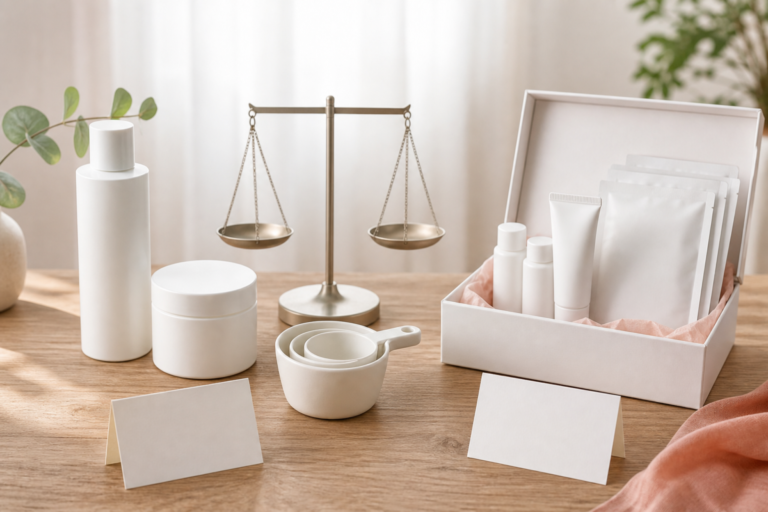
Use the net quantity printed on the package to calculate a comparable price. Divide the selling price by the number of milliliters or fluid ounces. If a 15 mL mini costs $9, its price is $0.60 per mL. If the 50 mL full size costs $24, its price is $0.48 per mL. The mini costs 25 percent more per milliliter, although it requires less cash up front.
For a multi-product kit, calculate each component only when the individual quantities are available. Add the milliliters if all items are reasonably comparable, but do not treat 10 mL of cleanser as economically interchangeable with 10 mL of serum. Their normal prices and application amounts differ. A kit discount is meaningful only if you would use most of the included products.
Look for a clearly stated net quantity rather than estimating from the container. The FDA summary of cosmetic labeling requirements explains that a retail cosmetic’s principal display panel must include an accurate net-quantity statement by weight, measure, count, or an appropriate combination. Decorative bottles, thick walls, and empty headspace can make visual size misleading.
Account for Trial Value and Waste
A trial must be long enough to answer the shopper’s actual question. One or two uses may reveal fragrance, pilling, immediate stinging, or whether makeup applies well over a cream. They cannot reliably establish long-term effects or rule out delayed irritation. A small sunscreen packet may show texture but may not contain enough product for repeated application at the labeled amount.
Estimate uses by dividing the net quantity by a realistic application amount. Pump output and product viscosity vary, so the result is approximate. A 10 mL serum used at 0.25 mL per application could provide about 40 applications; the same container used twice as heavily would last half as long. Sachets are less flexible because opening exposes the remaining contents and makes clean storage difficult.
Trial value is highest when the mini prevents a poor full-size purchase or serves a defined travel period. It is lowest when shoppers repeatedly buy minis of a product they already know and use. At that point, the full size often offers a lower unit cost and less packaging per use.
What a Small Cosmetic Package Should Tell You
Small size does not erase the need for meaningful consumer information. Cosmetics marketed in the United States, including imported Korean products, must meet applicable U.S. labeling requirements. Required information may appear on the outer carton, a firmly attached tag or card, or qualifying off-package materials when specific conditions are met. Shoppers should keep the outer package until they understand which mini matches each ingredient list and direction.
Ingredient and Identity Information
The product identity, net quantity, responsible business information, ingredient declaration, and any necessary warnings should be readable and associated with the correct item. The FDA Cosmetics Labeling Guide describes reduced type-size provisions for very small surfaces and explains how ingredient information may appear on tags, tapes, cards, or qualifying displays. A tiny bottle is not a reason for an online seller to provide no identifiable ingredient information.
Multiunit packages such as gift sets have their own presentation rules. FDA’s guide explains that ingredients for cosmetic units in a multiunit or multicomponent package are generally declared on the outside retail container. If an inside unit is also customarily sold separately, its own labeling obligations may apply. For consumers, the practical step is to photograph or retain the carton before discarding it.
Be cautious with decanted products sold by an unknown third party. A handwritten sticker may not establish what the product is, when it was filled, whether the container was sanitary, or whether the seller had permission to repackage it. Factory-sealed brand minis or clearly labeled authorized retail sets generally offer better traceability.
Dates, Batch Codes, and Storage
U.S. law does not generally require ordinary cosmetics to display an expiration date, although products regulated as drugs, such as many sunscreens and acne treatments, follow different requirements. FDA states on its cosmetic shelf-life page that manufacturers remain responsible for product safety and for determining shelf life. A missing date is therefore not proof of a violation, and a printed date is not the only quality clue.
Check for a lot or batch code, intact seal, normal texture, and consistent odor. Record the date you open the mini, especially if you transfer it into a travel container. FDA notes that heat, sunlight, air, moisture, repeated applicator contact, and dipping fingers into a jar can affect cosmetic stability or contamination risk. Do not leave minis in a hot vehicle or on a sunny windowsill simply because the package is small.
How to Pack Minis for U.S. Air Travel
For U.S. carry-on screening, skincare liquids, gels, creams, aerosols, and pastes generally fall under the Transportation Security Administration’s 3-1-1 liquids rule. The TSA travel guidance states that each container may hold no more than 3.4 ounces or 100 milliliters and that limited quantities must be packed according to the rule. The container’s maximum capacity matters; a partially filled 150 mL bottle does not become a 100 mL container.
Place eligible products in the required clear, resealable quart-size bag and check the current TSA “What Can I Bring?” guidance before departure. Screening officers make the final decision at the checkpoint, and international return flights may operate under local rules. Medically necessary liquids have separate procedures and should not be treated as ordinary beauty minis.
A simple travel routine is usually enough:
- Pack one gentle cleanser, one moisturizer, and any familiar essential treatment.
- Use leak-resistant factory minis or clean travel containers labeled with the product name.
- Keep sunscreen accessible and follow its labeled storage and application directions.
- Place caps tightly, use a secondary pouch, and avoid filling containers to the brim.
- Do not introduce several new actives during a trip where climate, sleep, and water already differ.
From Frisco, travelers using DFW or Dallas Love Field should plan around the same federal carry-on framework while allowing time for screening. The best travel kit is not the one with the most steps. It is the one that preserves a familiar routine, fits the bag, and remains easy to use consistently.
Risks, Limitations, and Shopping Mistakes
Minis are not automatically safer for sensitive skin. A shorter trial reduces financial exposure, not biological sensitivity. Stop use if a product causes persistent burning, swelling, blistering, or another concerning reaction. FDA’s consumer safety guidance advises reading the full label and reporting unexpected cosmetic reactions or product problems.
Avoid sharing open jars, eye products, lip products, or applicators. FDA warns that retail testers can be more likely to become contaminated than a product kept at home and recommends using a fresh, unused applicator if testing is necessary. A mini passed among several people can create the same hygiene concern.
Do not assume that every travel set qualifies for carry-on use simply because “travel” appears in the product name. Verify the printed capacity of every container. Likewise, do not assume that a sampler provides enough applications to prove brightening, wrinkle reduction, or acne improvement. Short trials are best for assessing usability and initial tolerance.
This article provides general consumer information, not legal, medical, or transportation advice. Airline, airport, international, and product-specific requirements can change. Check current official guidance and the product label before traveling or making a safety decision.
Conclusion & Key Takeaways
K-beauty minis can be excellent tools for texture testing, controlled discovery, and lighter travel, but their value depends on the goal. Compare unit prices, estimate realistic uses, retain labeling, buy traceable factory-sealed products, and separate a short usability trial from evidence of long-term results.
For flights, verify each container’s capacity and follow current TSA rules rather than relying on marketing language. A well-chosen mini kit should reduce waste and uncertainty. If it only adds unwanted products, repeated markups, or missing information, a carefully selected full size may be the better purchase.