North Texas creates a demanding real-world test for K-beauty distribution. A serum that leaves a climate-controlled warehouse in good condition may spend hours in a delivery vehicle, on a loading dock, or at a sunny front door before the customer opens it. That does not mean every warm package is unsafe, and it does not justify inventing a universal temperature limit. It does mean brands, retailers, and consumers should take storage conditions seriously. Dallas–Fort Worth climate normals show why summer planning matters, while U.S. Food and Drug Administration guidance explains that temperature changes, sunlight, air, moisture, and contamination can alter a cosmetic over time. This guide translates those principles into practical steps for receiving, storing, shipping, and evaluating K-beauty products in Frisco and across North Texas without making unsupported claims about a particular formula.
Why North Texas Requires a Heat-Aware Plan
The National Weather Service’s Dallas/Fort Worth annual climate normals list normal high temperatures of 95.6°F in July and 95.8°F in August for the 1991–2020 period. Its climate-normal summary also reports an average of about 20 days at or above 100°F per year in Dallas–Fort Worth. These are outdoor air figures, not package temperatures. A parcel in direct sun, a closed vehicle, or an unconditioned metal container can experience a different environment, so local weather should be treated as a planning signal rather than a product-specific stability test.
K-beauty assortments commonly include emulsions, watery essences, balms, hydrogel products, sheet masks, powders, and products with pumps or droppers. Their formulas and packages respond differently to environmental stress. The manufacturer’s labeled storage instructions and stability data should therefore control. A retailer should not assume that every item needs refrigeration, nor that every product tolerates the same shipping conditions.
What FDA Guidance Says About Cosmetic Storage
FDA’s Shelf Life and Expiration Dating of Cosmetics explains that shelf life depends on the product type, how it is used, and how it is stored. The agency identifies temperature changes and exposure to sunlight and air as factors that may change color and texture or cause odor. It also notes that heat can make preservatives break down and may allow bacteria and fungi to grow faster. FDA advises consumers not to leave cosmetics exposed to heat, such as in a hot car.
FDA also explains that U.S. law does not generally require cosmetics to display expiration dates, although manufacturers remain responsible for product safety and for determining shelf life. Products regulated as drugs, including certain products that are both drugs and cosmetics, have different expiration and stability obligations. Sunscreen and acne treatments are familiar examples where a shopper should follow the Drug Facts labeling and manufacturer instructions rather than treating the item as an ordinary cosmetic.
The agency’s cosmetic GMP inspection guidance adds a useful business principle: materials should be stored and handled to prevent contamination, mix-ups, and decomposition from excessive heat, cold, sunlight, or moisture. That principle supports a documented receiving and storage process even for a small inventory.
A Practical Summer Shipping Workflow
1. Classify products by evidence, not assumptions
Start with manufacturer specifications, package instructions, safety documentation, and available stability information. Identify items the manufacturer flags as temperature-sensitive. Separate ordinary cosmetics from OTC drug products and from any item with a specific storage range. Do not create a refrigerator category merely because a product feels premium or contains a fashionable ingredient; unnecessary refrigeration can also expose some packages to condensation or repeated temperature cycling.
2. Reduce avoidable dwell time
Schedule carrier pickup close to the end of packing, avoid leaving completed parcels in direct sun, and use a shaded or conditioned staging area. When feasible, ship earlier in the week so parcels are less likely to remain at a facility over a weekend. Delivery estimates are not guarantees, but reducing predictable delays is a practical control that does not depend on making claims about the formula.
3. Match packaging to the route and product
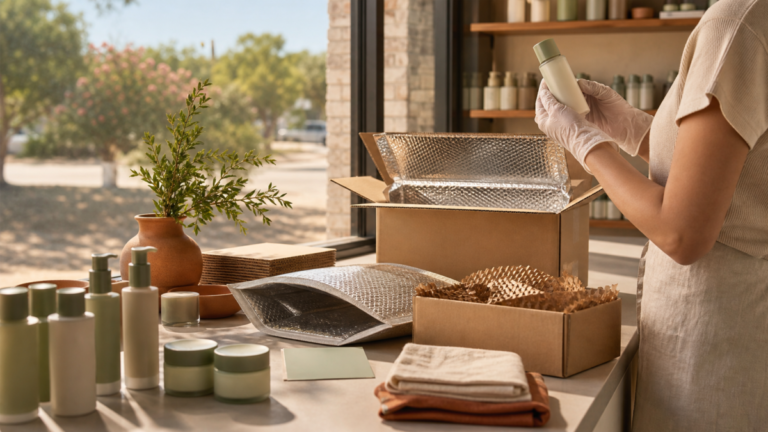
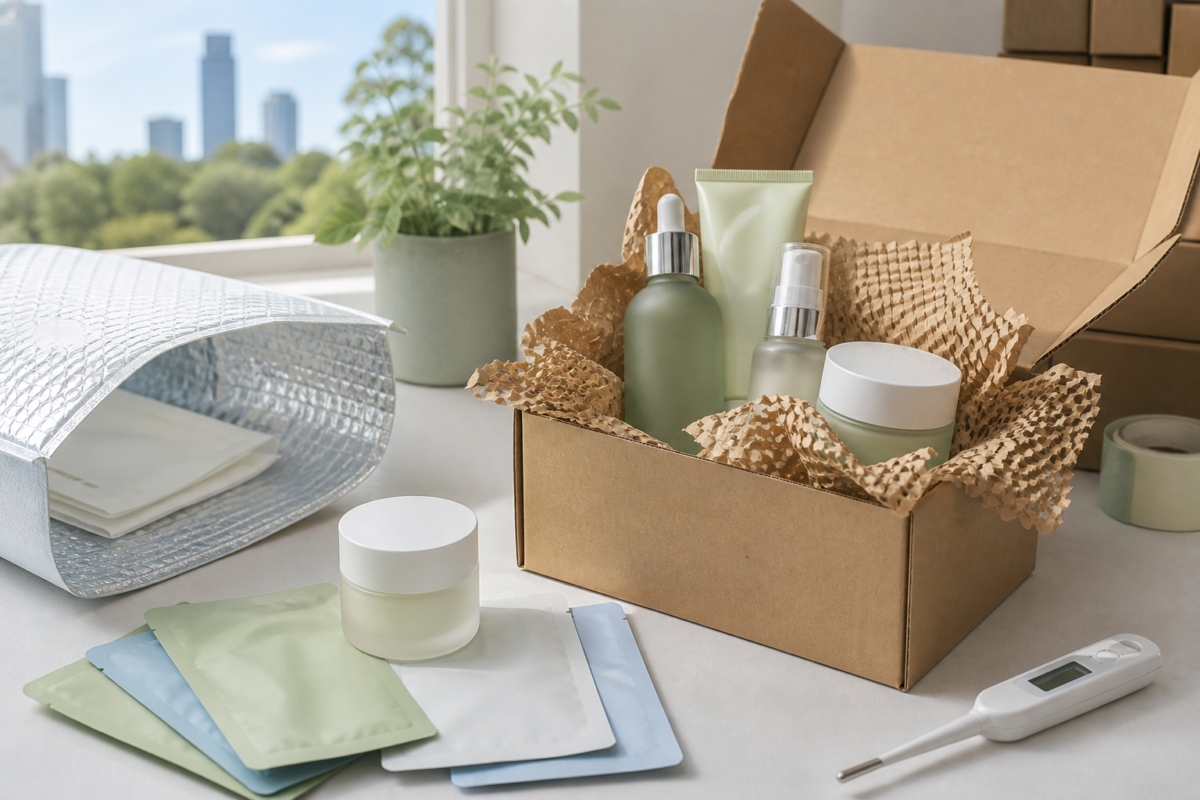
A corrugated box, appropriate cushioning, leak containment, and protection from crushing are baseline considerations. An insulated mailer may slow environmental change for selected shipments, but insulation is not active temperature control and should not be described as guaranteeing a safe temperature. Cold packs should be used only when supported by the product’s shipping requirements and a validated packing method. Direct contact between a frozen pack and a cosmetic can create localized cold stress, condensation, or package damage.
4. Help customers shorten porch exposure
Send accurate tracking notices and a delivery-day reminder. Encourage prompt retrieval without alarming the customer or declaring that a package becomes unsafe after an arbitrary number of minutes. Apartment lockers, business delivery, pickup points, or signature services may be useful options for high-value orders when available. The best message is specific and modest: retrieve the parcel promptly and follow the storage directions on the product.
5. Document exceptions and patterns
Record damaged cartons, leaks, broken seals, unusual odors, separation, color changes, and customer complaints by SKU, lot, route, and date. A single warm delivery does not prove a defect, and visual appearance alone cannot establish microbiological safety. However, repeated reports can identify a packing, carrier, package, or inventory-control problem that deserves investigation with the manufacturer.
Retail and Consumer Receiving Checklist
When a shipment reaches a Frisco store, pop-up, salon, or home, examine the outside before opening. Photograph crushing, punctures, saturation, or leakage. Check whether tamper-evident features and closures are intact. Compare the product with its normal appearance and manufacturer description rather than relying on a generic internet checklist.
- Move the parcel out of direct sun and into the labeled storage environment.
- Confirm the product name, lot code, quantity, and expiration date when one is provided.
- Quarantine leaking, swollen, cracked, opened, or visibly contaminated units.
- Do not sell a questionable unit merely because the container has cooled.
- Ask the manufacturer or authorized distributor for product-specific guidance when the condition is uncertain.
- Retain photos, lot information, delivery timing, and the response received.
Consumers should stop using a cosmetic that develops an unexpected smell, color, texture, or foreign material and can report product problems or adverse reactions to FDA. The agency’s Using Cosmetics Safely page provides practical safety and reporting information.
Inventory Controls for Texas Retailers
Create a defined storage zone
Keep sellable stock away from windows, exterior walls with strong solar exposure, uncontrolled garages, and vehicle trunks. Monitor the storage environment with a simple calibrated device appropriate to the operation. A temperature log is useful only when someone reviews excursions and knows which product specification applies.
Use consistent stock rotation
Apply first-expiring, first-out when expiration information is available and first-in, first-out when it is not. Keep lot codes connected to purchase and sales records. Do not obscure original labels with store stickers. Samples and testers need separate controls because repeated opening and consumer contact create contamination risks not shared by sealed retail units.
Ask suppliers precise questions
Useful questions include the labeled storage condition, supported transport range, allowable excursion process, lot-code interpretation, and the correct contact for quality complaints. Ask for written answers. A retailer should avoid converting a supplier’s general reassurance into a precise public guarantee that the evidence does not support.
What to Look Out For: Risks and Limitations
There is no single temperature or exposure time that determines the condition of every K-beauty product. Formula composition, packaging, starting temperature, duration, sunlight, humidity, repeated cycling, and microbial controls all matter. A weather report cannot replace product stability data. Likewise, an insulated mailer cannot prove that a required range was maintained unless the shipping system has been appropriately validated and monitored.
Do not make a safety determination solely from appearance, and do not promise that cooling a warm product restores it. This article provides general information, not scientific, medical, legal, or product-specific quality advice. Brands and retailers should consult the responsible manufacturer, qualified quality personnel, and regulatory professionals when an excursion or complaint may affect safety or compliance.
Conclusion and Key Takeaways
North Texas heat makes disciplined K-beauty handling especially valuable. FDA guidance establishes the central lesson: cosmetic shelf life depends partly on storage, and excessive heat, sunlight, air, moisture, and contamination can contribute to deterioration. NWS climate data show that Dallas–Fort Worth businesses should plan for sustained hot weather rather than treating it as a rare exception.
A practical program uses manufacturer instructions, short staging times, route-aware packaging, prompt delivery communication, documented receiving checks, controlled storage, and lot-level records. These steps do not eliminate every risk, but they create a credible process for protecting product quality and responding responsibly when a shipment arrives in questionable condition.