Centella asiatica has become one of the most recognizable ingredients in Korean skincare. It may appear as centella extract, cica, gotu kola, madecassoside, asiaticoside, madecassic acid, or asiatic acid. Products built around these names are frequently marketed for soothing, hydration, barrier support, and the appearance of stressed skin. The popularity is easy to understand: the ingredient has a long history of traditional use, fits the gentle-care identity of many K-beauty routines, and works well in lightweight toners, ampoules, gels, creams, and masks.
Popularity, however, is not the same as proof. A shopper should ask what form is present, how the finished formula was tested, and whether a claim refers to laboratory research, a small human trial, or the specific product being sold. This article reviews the evidence without treating skincare as medical care and provides a practical framework for reading labels.
What Centella Asiatica Means on a Label
Centella asiatica is a plant. A cosmetic can use a whole-plant extract or a preparation emphasizing particular triterpene compounds. Madecassoside and asiaticoside are commonly highlighted, while madecassic acid and asiatic acid may also appear. “Cica” is a convenient marketing term, but it does not tell the buyer which preparation, concentration, solvent, or standardization method was used.
Two products with centella on the front can therefore be very different. One may use a high proportion of a simple watery extract. Another may contain a smaller amount of a standardized component inside a formula dominated by humectants, emollients, and barrier-support ingredients. Both may be reasonable products, but the label headline alone cannot establish equivalence.
The Complete Formula Determines the Experience
A serum’s slip may come from glycols and polymers. Immediate hydration may come largely from glycerin or hyaluronic acid. A cream’s reduction in tightness may reflect emollients and occlusives. Centella can be part of the story without being the only reason the product feels effective. Packaging and preservation also matter because a contaminated or unstable product is not improved by a fashionable botanical.
Consumers should read the full ingredient declaration, directions, and warnings. Fragrance, essential oils, exfoliating acids, or other actives can change tolerance. A product promoted as soothing may still be unsuitable for a particular person.
What Human Research Can and Cannot Show
Clinical research exists, but studies differ in population, delivery method, formula, and outcome. A randomized double-blind trial indexed by PubMed evaluated oral and topical centella interventions in people with diabetes and dry skin. Another double-blind clinical study examined a combination of centella and ceramide in relation to skin-barrier measurements among Indonesian batik workers. These studies are useful signals, but neither means that every commercial cica toner will reproduce the same outcome.
Research on an oral extract also should not be used as direct proof for a topical cosmetic. Delivery route, dose, metabolism, and safety considerations differ. Even topical evidence may apply to a tested combination rather than a single ingredient. Good interpretation keeps the study question close to the marketing conclusion.
Measurements Are More Useful Than Dramatic Photos
Studies may evaluate transepidermal water loss, hydration, elasticity, redness, or clinician scores. These measurements can provide more structure than an uncontrolled photograph. Yet sample size, study duration, comparison group, and funding still matter. A statistically significant change may be small in daily life, and a favorable average does not guarantee an individual result.
For consumers, the reasonable conclusion is that centella preparations have research interest and plausible cosmetic uses, while evidence remains product-specific. The ingredient deserves informed attention, not universal promises.
Why Centella Fits the K-Beauty Market
K-beauty often emphasizes routine comfort, layering, and maintenance. Centella fits that message because it can be formulated in thin textures and paired with ceramides, panthenol, glycerin, or hyaluronic acid. It also gives brands a recognizable ingredient narrative that works across price levels.
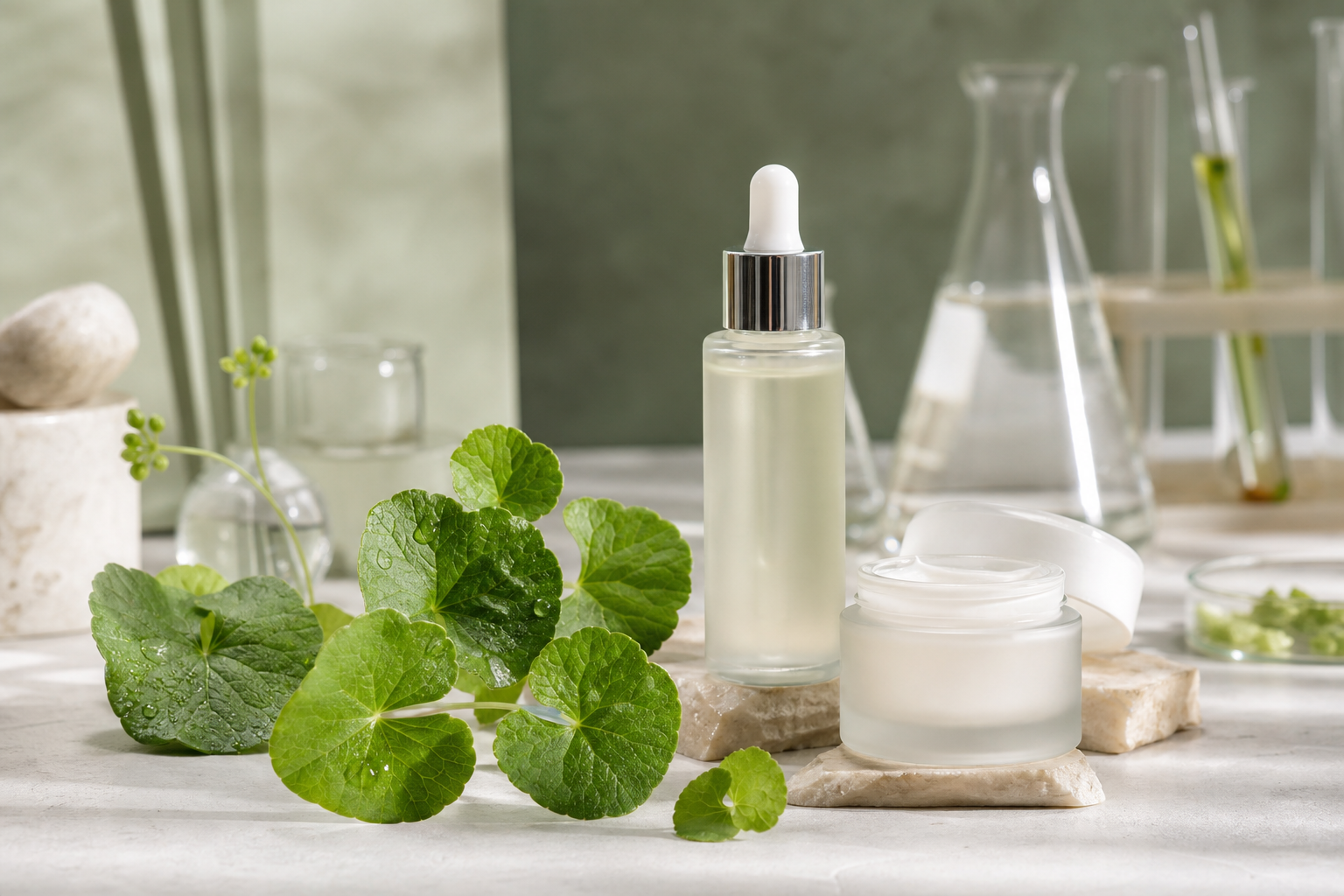
The ingredient is visually compatible with green packaging and nature-focused campaigns, but design should not substitute for substantiation. A responsible brand distinguishes traditional context, ingredient-level evidence, supplier data, and finished-product testing. Each supports a different kind of statement.
Positioning Should Remain Cosmetic
In the United States, claims can affect product classification. Describing a product as helping skin feel comfortable or improving the appearance of dryness is different from saying that it treats eczema, heals wounds, or changes a disease process. FDA explains that products intended to treat disease or affect body structure or function may be regulated as drugs rather than cosmetics. Brands should review labels, websites, retailer copy, and influencer briefs together because all can shape the intended-use message.
How to Compare Centella Products
- Identify the exact ingredient names. Look for centella extract and named components rather than relying only on “cica” on the front.
- Review the formula base. Humectants, emollients, fragrance, alcohol, and preservation influence performance and tolerance.
- Match the texture to the routine. A watery ampoule and a barrier cream solve different practical problems.
- Look for product-specific support. Finished-formula testing is more relevant than a general statement about the plant.
- Check seller and packaging integrity. Seals, lot information, storage, and an authorized supply chain support confidence.
Do not assume that a higher advertised percentage always produces a better product. Extract percentages can be difficult to compare because raw materials have different solids content and standardization. A balanced formula used consistently may outperform a dramatic number that creates an unpleasant texture.
A Practical Introduction Method
Add one unfamiliar product at a time. Review the label, use it according to directions, and consider a small-area test if you know your skin reacts easily. Stop using a product if significant irritation develops. People with persistent symptoms, broken skin, or diagnosed conditions should ask a qualified healthcare professional for individualized guidance.
Keep the rest of the routine stable during the first evaluation. This makes it easier to judge texture, comfort, pilling, and possible irritation. It also prevents a new centella product from receiving credit or blame for changes caused by several simultaneous additions.
Risks and Limitations
Botanical origin does not guarantee that an ingredient is non-irritating. Plant extracts contain multiple compounds, and sensitivity can occur. Product contamination, poor preservation, or counterfeit supply can create risks unrelated to centella itself. Marketing words such as natural, clean, and hypoallergenic are not substitutes for a complete safety assessment.
The available evidence is heterogeneous. Some studies test oral supplementation, some test combination formulas, and some focus on specific populations. Readers should avoid converting limited findings into medical advice. This article provides general cosmetic information and does not diagnose or treat a skin condition.
Conclusion and Key Takeaways
Centella asiatica has earned a meaningful place in K-beauty because it supports gentle-care product design and has scientific interest behind several preparations. The evidence is more nuanced than the marketing. Form, concentration, complete formula, tested outcome, and individual tolerance all affect what a product can realistically deliver.
The best buying approach is to read beyond “cica,” compare the entire formula, choose a texture that fills a real routine need, and evaluate gradually. Brands can build greater trust by explaining exactly what was tested and keeping cosmetic claims proportional to the evidence.